
This month’s crystal feature is fascinating Tourmaline. A mineral that occurs in more colours than any other, and has cool physical properties – like being able to generate electricity! Read on to find out more…
Table Of Contents
- INTRODUCTION
- WHAT IS TOURMALINE
- Physical Properties
- VARITIES
- Schorl
- Elbaite
- Liddicoatite
- Dravite
- COLLECTING
- METAPHYSICAL
- AVAILABLE IN SHOP

Introduction
This month’s feature is about one of my favourite stones, Tourmaline. I have quite a collection of black Tourmaline personally, I am always drawn to it! Tourmaline is one of the crystals I recommend as an absolute staple in anyone’s crystal collection – both from a collector’s point of view, and a crystal healing point of view.
We’ve recently gotten in a supply of beautiful pink Tourmaline (Rubellite) in Quartz, in association with pink to purple Lepidolite. Gorgeous and super affordable!
What Is Tourmaline?
Tourmaline is the name for a wide family of minerals with different chemical compositions and physical appearances. They all have boron and silica in common (scientifically: trigonal borosilicates of the cyclosilicate superclass) and a trigonal crystal system.
This group of crystalline boron silicate minerals was first identified in the 1800’s. Its name comes from mid-18th century French, based on Sinhalese “tōramalli”.
Physical Properties
Tourmaline has some awesome properties! It becomes electrically charged when heated (this is called pyroelectric). It is also piezoelectric (meaning it creates electricity under pressure / mechanical stress).
According to Hawthorne & Dirlam (2021), some tourmalines were used by Vikings as a navigational aid (as early piezoelectric gauges).
It occurs in more colours and colour combinations than any other gemstone in the world! The different colours have many different causes.
Most commonly, they’re due to the presence of certain minerals, including iron, manganese, chromium, copper and vanadium.
Tourmaline can form with stunning colour zoning, with multiple colours in different parts of the same specimen. Some varieties occur with cat’s eye chatoyancy and other colour changing effects. Such as pleochroism i.e displaying different shades when viewed from different angles
This incredible, detailed toad carving from Dreher Carvings is made completely out of multicolour Tourmaline!
The artist is Patrick Dreher, a 5th generation master gemstone carver. It’s an excellent example of Tourmaline occuring in multiple colours within one specimen.

Varieties
Let’s look at some of the varieties in the Tourmaline group that we stock:
SCHORL
Schorl is the black Tourmaline everyone is most familiar with. It’s always opaque, and black, though it can sometimes have a brownish or blueish tint to it. This is a sodium-based variety with a high percentage of iron causing the dark colour.
It’s often striated along the sides and good specimens can form with a ‘Mercedes’ (3 sided) point.

-
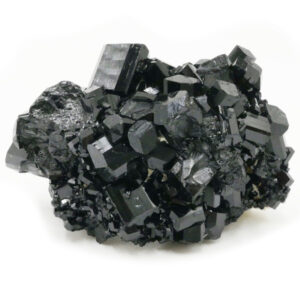 Tourmaline, Black Cluster 6cmR280,00
 -
 Tourmaline, Black A Grade Specimen 3cmR135,00
 -
 Tourmaline, Black Cluster 8cmR420,00
 -
 Tourmaline, Black Large Specimen 8cmR620,00

ELBAITE
Elbaite is a sodium and lithium variety. There are lots of well-known types within the Elbaite sub-group, such as:
- VERDELITE (green Tourmaline with iron and titanium)
- RUBELLITE (red to pink, with iron and manganese)
- INDICOLITE (rare blue Tourmaline, with iron)
- WATERMELON (pink centre surrounded by green exterior – like a watermelon)
- ACHROITE (very rare colourless Elbaite)
-
 Tourmaline, Pink Rubellite Crystal Healing BraceletR195,00
 -
 Tourmaline Multicolour Crystal BraceletPrice range: R180,00 through R250,00
 -
 Tourmaline, Multicolour Tumbled StonePrice range: R5,00 through R45,00
 -
 Tourmaline, Cotton Candy XL RARE 20cmR2480,00
 -
 Orchid Quartz Crystal Tower XL 20cm 1KGR2495,00
 -
 Pink Tourmaline in Quartz 9cmR560,00
OTHER TOURMALINE VARIETIES
- Liddicoatite, containing calcium, rarer than Elbaite and famed for its bright colours and colour zoning.
- Dravite, containing sodium and magnesium, a brown Tourmaline.
Collecting
Like collecting Calcite, you will never “finish” collecting Tourmaline, or even own one of every kind. There are just too many variables! To build a good collection, look for well formed specimens.
You can also choose to collect different colours and / or specimens from different localities. For example, my personal collection is mainly focused on high grade Schorl specimens, with a speciality interest in the Erongo locality. I’ve also collected a few colours – though these tend to be on the small side due to the rarity and high price tag. With the exception of an XL Candyfloss Tourmaline that makes an awesome cabinet specimen to compliment the rest of pieces. While it’s not super high quality, the rarity of the colours and the sheer size make up for that!


Keep track of where each specimen is from – locality is important for long-term value of your collection.
Notable localities include (but are not limited to) Erongo in Namibia, Madagascar (limited, occasional), Minas Gerais in Brazil, Merelani in Tanzania, Southern California in USA, Pakistan and Afghanistan.
A world-wide popular choice for mineral collectors, your Tourmaline collection is highly likely to increase in value over time if you invest in good pieces following the above guidelines.
Metaphysical
Tourmaline is a top protection stone. It forms a protective shield around the body, or space, as placed. It cleanses, purifies and transforms dense energy into a lighter vibration. Tourmaline can also clear the aura by removing blockages and dispersing negative energy. At the same time, it helps point to solutions for specific problems, making it a wonderful all-around healer.
“Black Tourmaline is a workhorse for your energy field, and one of my top 10 must-have crystals.”
Hibiscus Moon
Tourmaline can take you deep within yourself, strengthening your self-confidence and pushing aside your fear. It’s a powerful mental healer, which is said to greatly help dyslexia. Additionally, Tourmaline is strongly aligned with Devic energies and is lovely to use around your garden and plants as a natural protector and plant strengthener.
“Ancient magicians relied upon Black Tourmaline, known as Schorl, to protect them from earth demons as they cast their spells. Today this stone is still revered as a premier talisman of protection, a psychic shield deflecting and dispelling negative energies, entities, or destructive forces. It guards against radiation and environmental pollutants, and is highly useful in purifying and neutralizing one’s own negative thoughts and internal conflicts, and turning them into positive, usable energy.”
Crystal Vault
Individual varieties and colours have additional properties that you can explore.
For Sale In The Shop
-
Tourmaline, Black Cluster 6cmR280,00
-
Tourmaline, Black A Grade Specimen 3cmR135,00
-
Tourmaline, Black Cluster 8cmR420,00
-
Tourmaline, Black Large Specimen 8cmR620,00
-
 Tourmaline, Black Tumbled XS-SR5,00
 -
 Tourmalinated Quartz Crystal Tower 6.5cmR660,00
 -
Tourmaline, Cotton Candy XL RARE 20cmR2480,00
-
 Tourmaline, Black Alluvial Specimen 5cmR180,00


